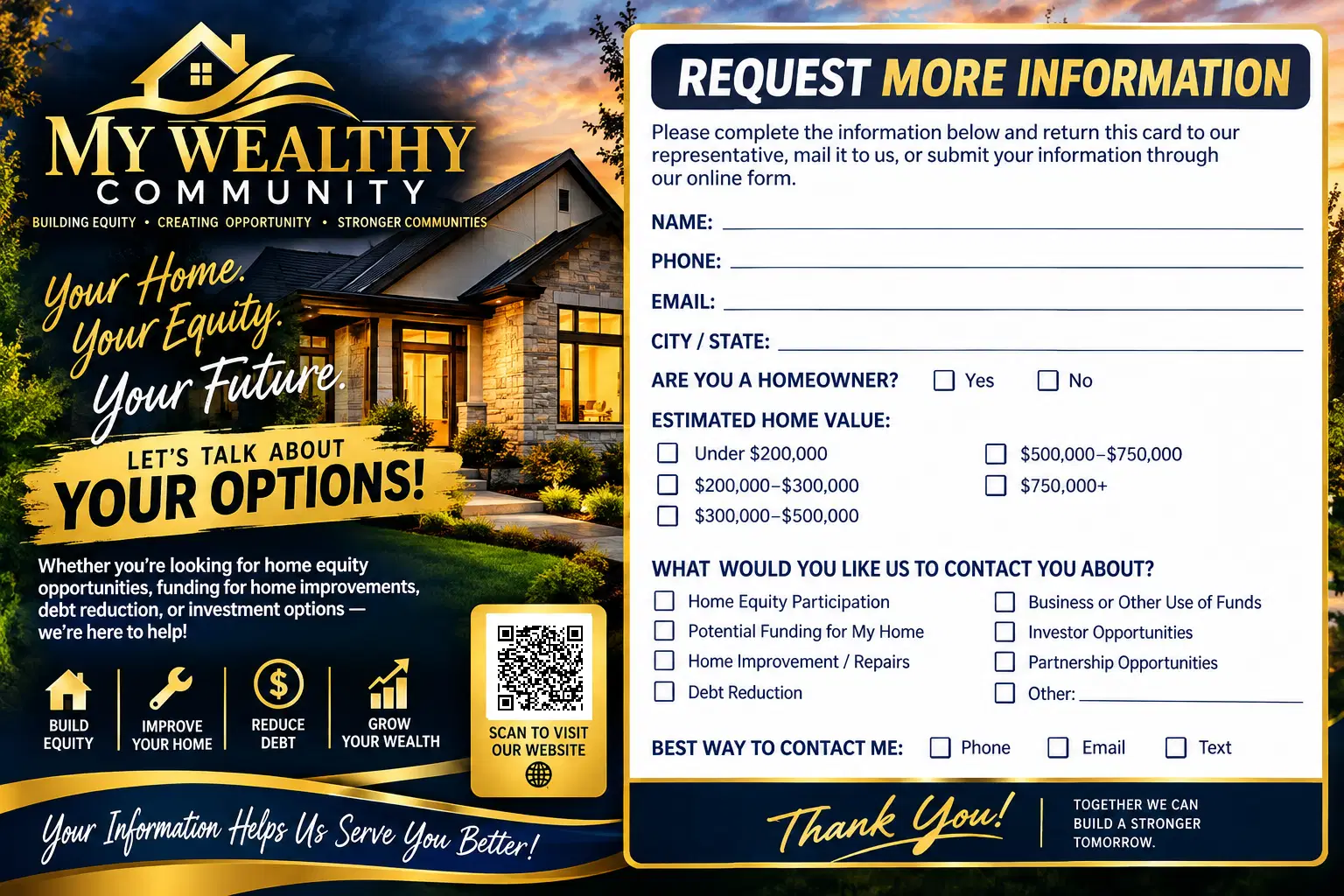
Why Insurance Companies Should Pay Attention to Homeowner Equity Programs

Homeowner equity programs are becoming part of the conversation when people look for ways to access the value in their homes. For insurance professionals, that creates an opportunity to stay involved, not only when a policy renews or a claim occurs, but when a client is considering a significant decision about their home.
MY WEALTHY COMMUNITY, LLC enrolls 100–300 homeowners per month through its member-supported program. In this program, homeowners retain 85% of their equity. The arrangement has no monthly payment structure for the homeowner, does not change the rate on an existing mortgage, and is not a traditional loan.
Those details matter. So does the relationship you already have with your clients.
A financial decision can become an insurance conversation
When a homeowner considers an equity arrangement, they may ask their insurance agent questions such as:
- Does this change anything about my homeowners policy?
- Does another party need to be listed or notified?
- Could the agreement affect what happens after a claim?
- Should I review my coverage or home details before proceeding?
The answers depend on the specific agreement, the insurance policy, applicable endorsements, and relevant requirements. An equity arrangement is not automatically a reason to replace a homeowners policy. But it is a good reason for a client to discuss the arrangement with their insurance professional and review any relevant policy or agreement language.
That conversation gives you a chance to help the homeowner understand what should be checked, direct them to the appropriate documents, and stay present as a trusted advisor.

Start with the facts, not assumptions
“Home equity program” can describe different arrangements. The Consumer Financial Protection Bureau’s overview of home equity contracts explains that contract terms and structures vary. It also notes that these agreements can raise questions about insurance, property obligations, and the rights of parties with an interest in a home.
That is useful context, but it is not a description of every program. Do not assume that one provider’s terms apply to another. Review the specific documents.
For MY WEALTHY COMMUNITY’s program, the points relevant to an initial conversation are straightforward:
- The homeowner keeps 85% of their equity.
- There is no monthly payment structure for the homeowner under the arrangement.
- The rate on the homeowner’s existing mortgage is untouched.
- The arrangement is not a traditional loan.
- MY WEALTHY COMMUNITY enrolls 100–300 homeowners per month through its member-supported program.
These are program facts, not a substitute for reviewing the homeowner’s documents. Existing mortgage obligations and ordinary responsibilities related to the home still matter. The homeowner should read the agreement, understand its terms, and ask questions before deciding whether to proceed.
Why your role matters
Your client may not expect you to evaluate an equity agreement. You do not need to do that to be valuable.
Your role is to help them identify the insurance questions that belong in the conversation. For example, you can encourage a client to:
- Share the relevant documents. Ask the homeowner to provide the agreement or any insurance-related instructions they received.
- Review the policy details. Confirm what the current policy says and whether a change or additional information may be needed.
- Clarify interested-party requirements. Do not assume that a new party should be added in a particular capacity. Check the agreement, policy language, and applicable procedures.
- Discuss claim and notice questions. If the documents describe notice, payment, or claim-related requirements, determine what your agency can clarify and what should be referred to the appropriate party.
- Record the conversation. Follow your agency’s normal documentation and service practices.
The point is not to make the equity decision for the client. It is to make sure they know to include their insurance professional and to check their policy in the context of the actual agreement.

Better conversations can support client retention
When a homeowner makes a major financial decision about their property, they may turn to several professionals for information. If their insurance advisor is left out, the client may have unanswered questions, or may look elsewhere for guidance.
A prepared agent can help keep the relationship connected by being clear about what they can review, what needs confirmation, and where the client should go next. That is sound service, whether or not the client ultimately participates in an equity program.
This is especially relevant for agencies serving homeowners who want access to home equity while avoiding a new monthly payment structure or a change to their existing mortgage rate. Those features may prompt questions, but they do not eliminate the need to review the agreement and the homeowner’s insurance situation.
A simple client message can help:
“If you’re considering a home equity arrangement, please share the documents with us before you proceed. We can review the insurance questions within our role and let you know if we need additional information.”
That keeps the door open without overstating what an agent can advise on or promising a coverage outcome.
A practical opportunity for insurance organizations
Insurance companies, agencies, brokers, and agents can prepare by giving their teams a consistent process for these inquiries. That process does not need to be complicated.
Consider making sure your staff know how to:
- Recognize when a client is discussing a home equity agreement or participation arrangement.
- Ask for the relevant agreement and any insurance-related instructions.
- Route policy, endorsement, and claims questions to the right person.
- Avoid assuming that all programs use the same terms.
- Explain when legal, tax, or financial questions are outside the scope of insurance guidance.
This approach can help your organization respond consistently while keeping the homeowner’s experience clear and professional. It also makes your team more prepared for a topic clients may bring to you as they explore options for their homes.

Open a conversation with MY WEALTHY COMMUNITY
MY WEALTHY COMMUNITY enrolls 100–300 homeowners per month through its member-supported program. As homeowners explore the arrangement, insurance professionals may be among the trusted advisors they contact with questions about their coverage and next steps.
We welcome a conversation with insurance companies, agencies, brokers, and agents interested in understanding the program and the questions it may raise for homeowners. This is an invitation to learn more, not a statement of agreed referral terms, compensation, or a formal partnership arrangement. Any potential working relationship would need to be discussed and documented separately.
To review the program, visit MY WEALTHY COMMUNITY or its program information page. For program-related questions, contact the company at 307-785-1543.
Keep the homeowner, and the documents, in view
Home equity decisions can create new questions for homeowners and their advisors. Insurance professionals do not need to become experts in every equity arrangement to serve clients well. They do need to stay engaged, review the relevant policy and agreement details, and make clear what can be addressed within their role.
That is the opportunity: help your clients navigate an important decision with their insurance relationship intact. If your organization would like to learn more about MY WEALTHY COMMUNITY’s program, open a conversation with our team.
This article is general information, not insurance, legal, tax, or financial advice. Program terms and insurance requirements may depend on the specific agreement, policy, endorsements, and applicable law. Homeowners should review their documents and consult the appropriate professionals before making a decision.